Graph Engineering for Multi-Agent AI: Why the Edges Matter
Watch on YouTube: Graph Engineering for Multi-Agent AI
Source: original Russian video
Making one model sound intelligent is only part of a multi-agent product. You also have to decide which worker sees which context, which output is trustworthy, and where each artifact goes next. That is the graph engineering problem.
Euler’s bridges and AI agents
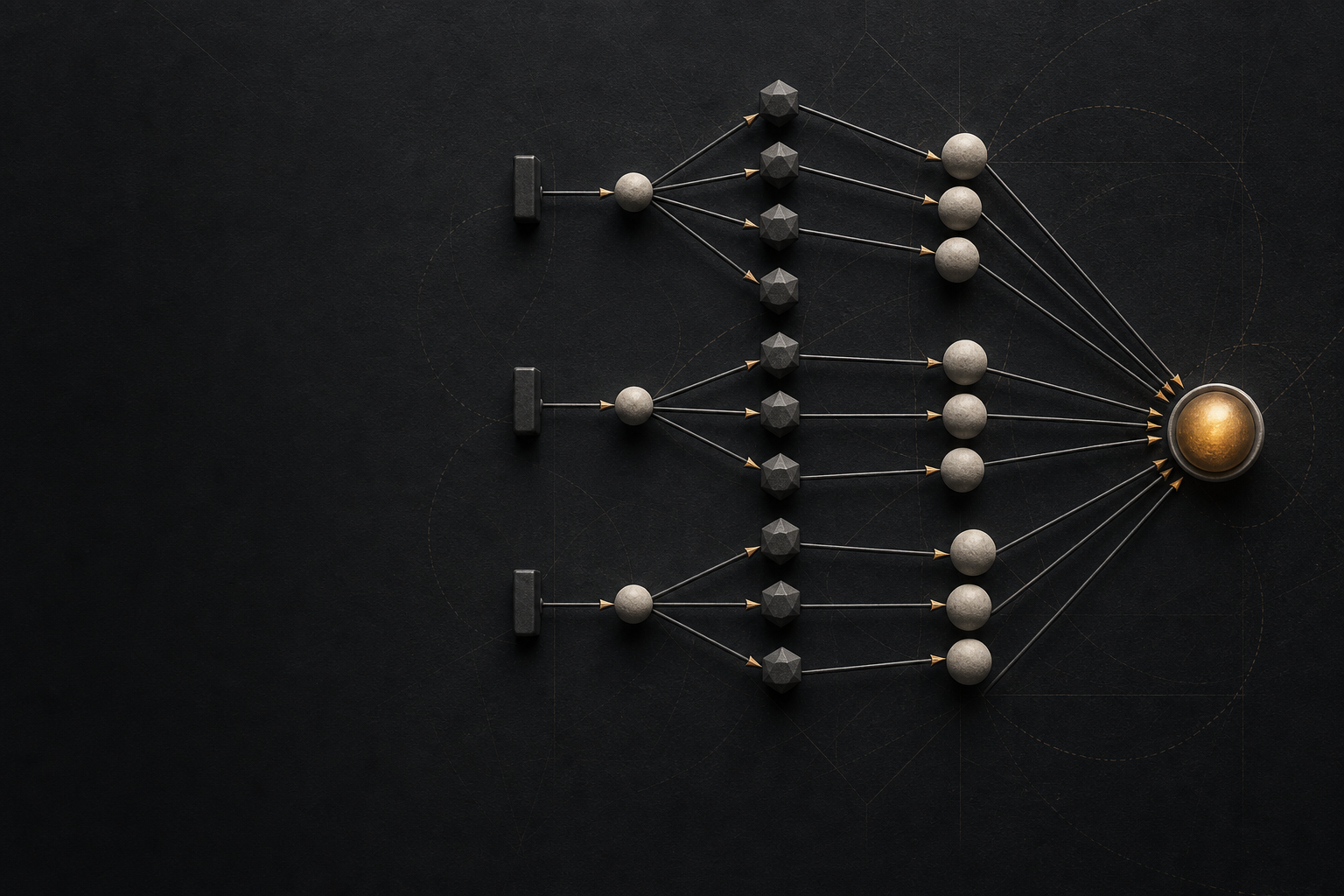
Euler’s seven bridges problem becomes manageable once the city map is reduced to a graph: land areas become nodes and bridges become edges. A multi-agent system has the same structure. The agents are nodes; messages, tool calls, artifacts, and review hand-offs are edges. As the system grows, the edges may matter as much as the raw capability of any one model.
Why one giant prompt fails
A single model with a huge prompt looks simple at first. Then search results, notes, instructions, and unfinished reasoning begin competing for the same context window. The model has to decide what to retain while still working on the task.
Division of labor is usually easier to reason about. Give each worker a narrow system prompt, a clean context window, and one measurable responsibility. A collector finds sources. An extractor turns a source into structured facts. A verifier checks claims. A writer assembles the report. The orchestrator connects those workers instead of making one overloaded model do every job.
A research pipeline as a DAG
A useful architecture is a forward-only directed acyclic graph:
- A planner turns the question into a research plan.
- Collectors find relevant material.
- Extractors turn sources into focused evidence.
- Verifiers check evidence, contradictions, and citations.
- A writer turns the verified record into a readable answer.
The source video uses an illustrative setup with 1 planner, 5 collectors, 25 extractors, 75 verifiers, and 1 writer. It also gives other totals, including 180 and 108, although the listed stages add up to 107. Treat those numbers as an architectural example, not a verified benchmark. The important part is the shape of the work: it fans out for independent evidence gathering and narrows again through verification before synthesis.
Context isolation makes faults visible
Narrow prompts can keep irrelevant context from crossing stages. A verifier needs a claim, supporting excerpts, and verification rules. It does not need the full search history or another worker’s internal reasoning. When a final answer is wrong, inspect the hand-off: did the collector return a weak source, did the extractor lose a qualifier, or did the verifier receive the wrong evidence?
This can make retries cheaper. You can rerun a failed extractor without replaying the whole report, and each artifact can have a defined parent and child relationship.
Prompt caching can lower repeated input cost
Agent networks often reuse the same system instructions. If dozens of verifiers share a long immutable prefix, caching it can reduce repeated input work. The source estimates a drop from about $10 to about $1 per run. That is an illustrative claim from the source, not an independently verified cost benchmark. The general pattern is still useful: keep stable instructions separate from task-specific evidence, cache what repeats, and measure cost where it occurs.
The difficult part is the wiring
Many current agents can read code, browse, call tools, inspect errors, and retry. The harder question is how the graph is wired: what a worker knows, what it produces, and where that artifact goes next.
Build the graph like a production system. Define typed inputs and outputs. Record provenance. Add timeouts and retry budgets. Make each hand-off observable. Keep cycles out of the research path unless you need a deliberate review loop. Test the whole graph with adversarial inputs, not only isolated nodes. A capable model is useful, but a dependable product also needs dependable connections between its workers.